 HL Fundamentals
Library / Jun 2, 2026
What Total Open Interest Really Tells Us About Hyperliquid's Fundamentals
A practical guide to reading Hyperliquid Total Open Interest as a signal for liquidity, trust, market participation, and structural risk.
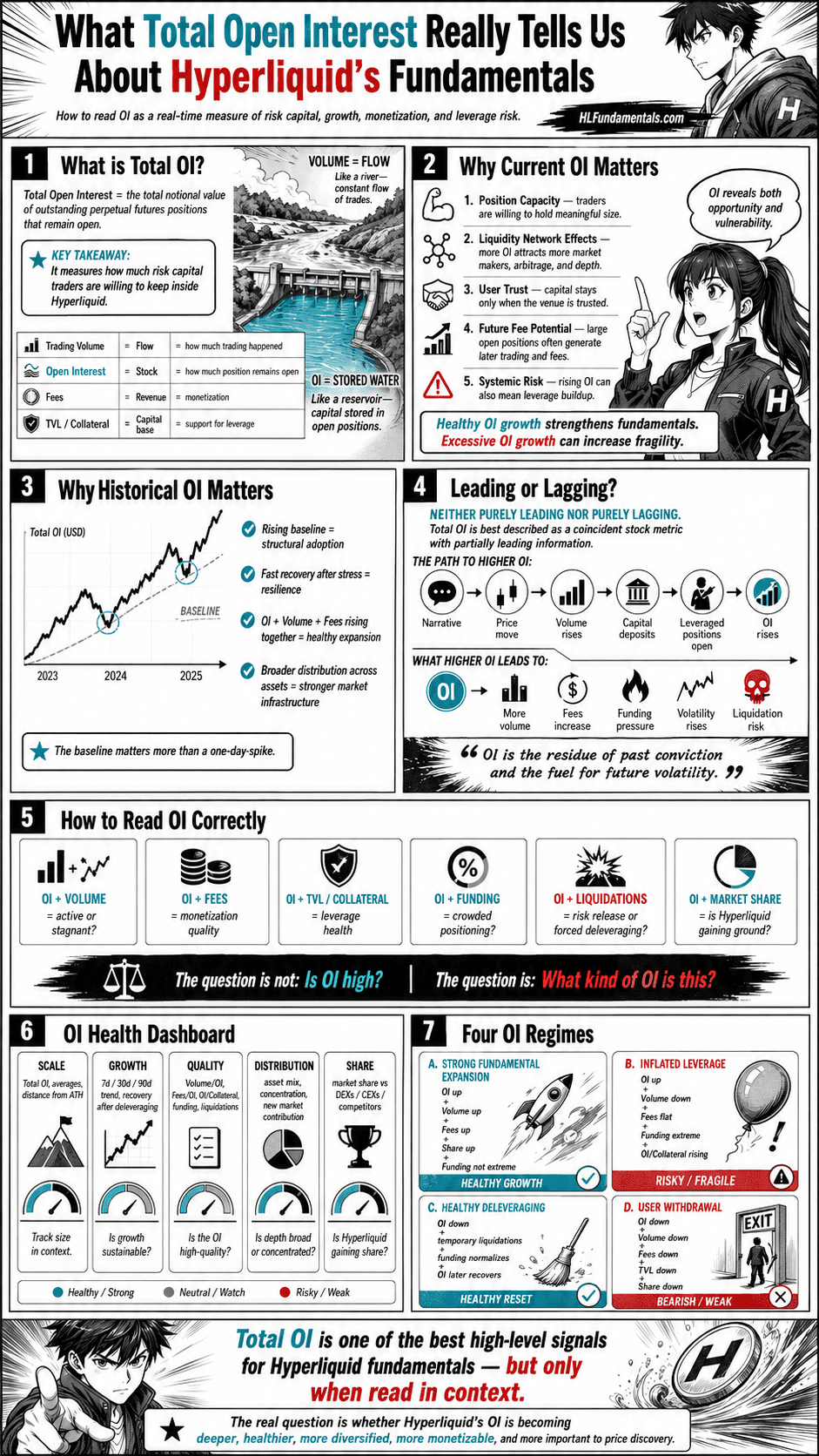
Total Open Interest is one of the most important metrics for understanding Hyperliquid, but it is also one of the easiest to misread.
At first glance, it looks simple: Open Interest measures the total notional value of outstanding perpetual futures positions that have not yet been closed. But for a perpetuals exchange like Hyperliquid, Total Open Interest is much more than a trading statistic.
It tells us how much risk capital is currently committed to Hyperliquid.
In other words:
Total Open Interest measures how much leveraged exposure traders are willing to keep inside Hyperliquid’s system.
That makes it a powerful signal for understanding Hyperliquid’s liquidity, user trust, trading demand, market share, and systemic risk.
But it should never be interpreted in isolation.
Open Interest Is Not Volume
The first thing to understand is the difference between Open Interest and Trading Volume.
Trading Volume measures how much trading activity happened over a period of time.
Open Interest measures how much outstanding position remains open at a specific point in time.
A simple way to think about it:
| Metric | What It Measures | Interpretation |
|---|---|---|
| Trading Volume | Flow | How much trading passed through the exchange |
| Open Interest | Stock | How much position remains open on the exchange |
| Fees | Revenue | How much value trading activity generated |
| TVL / Collateral | Capital Base | How much capital users have deposited |
| Active Traders | User Activity | How many participants are using the platform |
Volume is movement.
Open Interest is commitment.
A trader may generate high volume by entering and exiting quickly. But Open Interest only remains when traders keep positions open. That makes OI especially useful for evaluating whether Hyperliquid is merely attracting short-term trading activity, or whether it is becoming a place where serious risk exposure is being held.
Why Current Total Open Interest Matters
Current Total Open Interest shows how much risk exposure Hyperliquid is carrying right now.
For a perpetual futures exchange, this matters in several ways.
1. It Measures Hyperliquid’s Position Capacity
A high level of Open Interest means traders are willing to hold large positions on Hyperliquid.
This is not trivial.
Large traders, market makers, arbitrageurs, and sophisticated funds care deeply about execution quality, liquidity, liquidation mechanics, oracle reliability, withdrawal reliability, and system stability.
If OI is high, it suggests that traders are not just visiting Hyperliquid to test the product. They are willing to leave meaningful leveraged exposure inside the system.
For a derivatives venue, this is a core sign of product-market fit.
2. It Reflects Liquidity Network Effects
Open Interest tends to attract more Open Interest.
When a venue has deep positions, it attracts:
- More market makers
- More arbitrageurs
- More directional traders
- More hedgers
- More liquidity-sensitive users
This creates a liquidity flywheel.
More OI improves market depth. Better depth attracts larger traders. Larger traders create more activity. More activity creates more fees, more data, better price discovery, and stronger market share.
For Hyperliquid, rising Total OI can therefore indicate that it is becoming an increasingly important liquidity hub in the perpetuals market.
3. It Signals User Trust
Trading volume can be temporary.
Incentives can create volume. Campaigns can create volume. Volatility can create volume.
Open Interest is harder to fake because it represents risk that users continue to carry.
When traders keep positions open on Hyperliquid, they are implicitly trusting the platform’s:
- Matching engine
- Liquidation system
- Oracle design
- Margin system
- Withdrawal process
- Risk controls
- Uptime
- Execution fairness
This is why OI is such a meaningful trust signal.
A strong derivatives exchange is not only measured by how many trades happen. It is measured by whether capital is willing to stay.
4. It Indicates Future Fee Potential
Open Interest does not directly equal revenue.
But it is often the fuel for future trading activity.
Large outstanding positions tend to generate future:
- Rebalancing
- Take-profit activity
- Stop-loss activity
- Liquidations
- Hedging
- Arbitrage
- Funding-rate trades
- Position rollovers
This means high OI can support future volume and future fees.
However, the link is not automatic. If OI rises but trading volume and fees do not rise, then OI may simply represent stagnant position inventory rather than healthy trading demand.
That is why OI must always be analyzed together with volume and fees.
5. It Also Measures Systemic Risk
Open Interest is not always bullish.
High OI means high risk concentration.
If Total OI rises quickly while leverage increases, collateral quality weakens, funding becomes extreme, and positioning becomes one-sided, then the exchange may be entering a fragile state.
In that case, rising OI is not a clean sign of growth. It may be a sign of leverage buildup.
This is the dual nature of Open Interest:
Healthy OI growth strengthens fundamentals. Excessive OI growth can create liquidation risk.
Why Historical Open Interest Matters
Current OI tells us where Hyperliquid stands today.
Historical OI tells us whether the trend is structural.
The most important question is not whether OI is high on a single day. The more important question is whether Hyperliquid’s OI base is rising over time.
1. Is the OI Baseline Moving Higher?
A single spike in Open Interest may simply reflect a short-term volatility event.
But if Hyperliquid’s average OI keeps moving from one range to a higher range, that suggests structural adoption.
For example, if OI moves from a long-term range of $2 billion, to $5 billion, to $8–10 billion, the important signal is not the peak. The important signal is the new baseline.
A rising OI baseline means Hyperliquid is supporting more persistent risk capital over time.
That is much more meaningful than one temporary spike.
2. How Quickly Does OI Recover After Stress Events?
One of the best tests for any derivatives venue is what happens after stress.
During crashes, liquidations, market panic, oracle disputes, congestion, or volatility shocks, OI often falls sharply.
The key question is:
After deleveraging, does OI come back?
If OI drops and never recovers, that may suggest loss of confidence.
If OI drops but quickly returns to previous levels, that suggests strong user retention and platform resilience.
A healthy exchange does not avoid stress. A healthy exchange survives stress and regains user trust afterward.
For Hyperliquid, OI recovery after market stress is one of the most important signals to monitor.
3. Does OI Growth Translate Into Volume and Fees?
Not all OI growth is equal.
Healthy growth should look like this:
Open Interest rises. Trading Volume rises. Fees rise. Market depth improves. Slippage decreases. Funding remains relatively stable.
Unhealthy growth looks different:
Open Interest rises. Volume does not rise. Fees do not rise. Funding becomes extreme. Positions become crowded. Liquidation risk increases.
In the first case, OI is a sign of fundamental expansion.
In the second case, OI may be a sign of leverage accumulation.
4. Is OI Becoming More Distributed Across Markets?
Total OI alone does not show market structure.
If most OI comes only from BTC and ETH, Hyperliquid may be strong in major perpetual markets, but not necessarily broad-based.
If OI begins to spread across major altcoins, long-tail assets, ecosystem assets, pre-IPO markets, and HIP-3 markets, the interpretation changes.
That would suggest Hyperliquid is not only growing as a trading venue, but also expanding as a broader onchain financial infrastructure.
For Hyperliquid, OI distribution is extremely important.
A rising Total OI number is useful. But a rising and diversifying OI base is much more powerful.
Is Total Open Interest a Leading or Lagging Indicator?
Open Interest is often misunderstood because it does not fit neatly into one category.
It is not a pure leading indicator.
It is not a pure lagging indicator either.
A more precise description is:
Total Open Interest is a coincident stock metric with partially leading information.
That means it primarily reflects the current state of the market, but it can also provide clues about future trading activity, fee generation, liquidity demand, and liquidation risk.
Why OI Is Not a Pure Leading Indicator
Open Interest is created after traders open positions.
Usually, the sequence looks like this:
- Market narrative strengthens
- Price starts moving
- Trading volume increases
- Traders deposit capital
- Traders open leveraged positions
- Open Interest rises
In this sense, OI is partly a result of previous market behavior.
It tells us that market interest has already turned into actual positions.
So OI has some lagging characteristics.
Why OI Has Leading Value
Once positions are open, they affect the future.
High OI can lead to:
- More trading volume
- More fees
- Higher liquidation risk
- More volatility
- More funding-rate pressure
- More arbitrage activity
- More market-maker demand
This is why OI can also be forward-looking.
It is created by past trading behavior, but it becomes fuel for future market behavior.
A useful way to summarize it:
Open Interest is the residue of past conviction and the fuel for future volatility.
For Hyperliquid fundamentals, this makes OI especially valuable.
It helps us understand both the current level of adoption and the future pressure inside the system.
The Right Way to Use Total OI in Hyperliquid Fundamental Analysis
Total OI should not be treated as a standalone bullish or bearish signal.
It should be treated as one part of a broader analytical framework.
The most important question is not:
Is Open Interest high?
The better question is:
What kind of Open Interest is this?
Is it healthy, revenue-generating, diversified, and market-share-expanding?
Or is it crowded, overleveraged, unstable, and fragile?
To answer that, Total OI should be combined with several other metrics.
1. OI + Volume: Is It Active or Stagnant?
The first combination is Open Interest and Trading Volume.
This tells us whether outstanding positions are generating actual trading activity.
| Open Interest | Volume | Interpretation |
|---|---|---|
| Rising | Rising | Healthy expansion |
| Rising | Flat | More positions, but limited activity |
| Rising | Falling | Possible position buildup and rising risk |
| Falling | Rising | Deleveraging, liquidations, or heavy rotation |
| Falling | Falling | Market cooling or user withdrawal |
A useful derived metric is:
Volume / Open Interest
This ratio measures how much trading activity is generated per dollar of outstanding position.
If OI is high but Volume/OI is low, the market may be full of inactive positions.
If OI is moderate but Volume/OI is high, the venue may be highly active and fee-efficient.
For Hyperliquid, this ratio helps distinguish between passive position accumulation and real trading intensity.
2. OI + Fees: Can Positioning Become Revenue?
OI shows potential.
Fees show monetization.
A strong fundamental signal appears when OI growth is accompanied by fee growth.
Useful metrics include:
| Metric | Meaning |
|---|---|
| Fees / OI | Fee generation per unit of open position |
| 7-day Fees / Average OI | Short-term monetization efficiency |
| Fee Growth vs OI Growth | Whether revenue is keeping up with position growth |
| Assistance Fund Inflows | How trading activity flows back into the ecosystem |
If OI grows but fees do not, the platform may be carrying more risk without generating proportionally more value.
If OI and fees rise together, the signal is much stronger.
3. OI + TVL / Collateral: Is Leverage Healthy?
Open Interest is notional exposure.
Collateral is the capital base supporting that exposure.
That makes the ratio between OI and collateral extremely important.
A useful metric is:
Open Interest / Perp Collateral
or more broadly:
Open Interest / TVL
This helps measure system-wide leverage pressure.
| OI / Collateral | Interpretation |
|---|---|
| Gradually rising | Improving capital efficiency |
| Rapidly rising | Increasing leverage pressure |
| Extremely high | Potential fragility |
| Falling | Deleveraging or risk reduction |
If OI grows because more collateral is entering the system, that is relatively healthy.
If OI grows much faster than collateral, the system may be becoming more fragile.
4. OI + Funding: Is the Market Crowded?
Funding rates help reveal positioning pressure.
When OI rises together with extreme funding, it often means the market is becoming crowded.
| Open Interest | Funding | Interpretation |
|---|---|---|
| Rising | Mildly positive | Healthy long demand |
| Rising | Extremely positive | Crowded longs, higher downside risk |
| Rising | Extremely negative | Crowded shorts, squeeze risk |
| Falling | Funding normalizes | Deleveraging may be completing |
| High | Funding volatile | Unstable market structure |
This is especially important for perpetuals.
High OI with neutral or moderate funding can be healthy.
High OI with extreme funding is dangerous.
5. OI + Liquidations: Has Risk Been Released?
Liquidations help explain why OI changes.
If OI falls sharply, the reason matters.
Was it because traders voluntarily closed positions?
Or because they were forcibly liquidated?
| Open Interest | Liquidations | Interpretation |
|---|---|---|
| Sharp decline | High liquidations | Forced deleveraging |
| Sharp decline | Low liquidations | Voluntary position reduction |
| High OI | Low liquidations | Stable positioning for now |
| High OI | Frequent liquidations | Fragile leverage structure |
| OI recovers after liquidations | Strong user retention and risk appetite |
For Hyperliquid, liquidation behavior is critical because it shows whether risk is being managed smoothly or violently.
A temporary liquidation wave is not necessarily bad. It may reset leverage and create a healthier base.
But repeated liquidation spikes while OI remains high may indicate structural fragility.
6. OI + Market Share: Is Hyperliquid Gaining Ground?
For fundamental analysis, absolute growth is not enough.
Hyperliquid’s OI must also be compared with the broader perpetuals market.
Important metrics include:
| Metric | Meaning |
|---|---|
| Hyperliquid OI / Perp DEX OI | Share among decentralized perpetual exchanges |
| Hyperliquid OI / Total Perp Market OI | Share across CEXs and DEXs |
| Hyperliquid Volume Share | Trading activity share |
| Hyperliquid Fee Share | Revenue share |
| BTC/ETH OI Share | Competitiveness in major markets |
| Long-tail OI Share | Competitiveness in emerging markets |
If Hyperliquid’s OI is flat while the broader market is declining, Hyperliquid may still be gaining share.
If Hyperliquid’s OI is rising but the overall market is rising faster, Hyperliquid may be losing relative position.
Market share gives context to growth.
Without it, OI can be misleading.
A Practical Framework: The OI Health Dashboard
For HL Fundamentals, Total OI should be turned into a broader Open Interest Health framework.
The goal is not only to show how large OI is, but to assess the quality of that OI.
A useful dashboard could include five sections.
1. Scale
This measures how much risk capital Hyperliquid currently supports.
Key metrics:
- Total Open Interest
- 7-day average OI
- 30-day average OI
- OI distance from all-time high
- OI drawdown from all-time high
- OI by asset
- OI by market category
Core question:
How large is Hyperliquid today?
2. Growth
This measures whether Hyperliquid’s position base is structurally expanding.
Key metrics:
- 7-day OI growth
- 30-day OI growth
- 90-day OI growth
- OI moving averages
- Higher highs and higher lows in OI
- OI recovery after deleveraging
Core question:
Is Hyperliquid’s OI baseline moving higher?
3. Quality
This measures whether OI is healthy or fragile.
Key metrics:
- Volume / OI
- Fees / OI
- OI / TVL
- OI / Perp Collateral
- Funding dispersion
- Liquidations / OI
Core question:
Is this OI productive, monetizable, and sustainable?
4. Distribution
This measures how diversified Hyperliquid’s OI base is.
Key metrics:
- Top 5 markets’ OI share
- BTC + ETH OI share
- Altcoin OI share
- Long-tail OI share
- Ecosystem asset OI
- New market OI contribution
- OI concentration index
Core question:
Is Hyperliquid dependent on a few markets, or is its trading network expanding?
5. Share
This measures Hyperliquid’s relative position in the broader market.
Key metrics:
- Perp DEX OI share
- Perp DEX volume share
- CEX vs DEX OI share
- Hyperliquid vs competitor OI growth
- Hyperliquid BTC/ETH OI share
- Hyperliquid long-tail OI share
Core question:
Is Hyperliquid growing faster than the market?
How to Interpret Different OI Regimes
The most useful insights come from combinations of metrics, not from OI alone.
Strong Fundamental Expansion
A strong signal looks like this:
OI rising Volume rising Fees rising Market share rising Funding not extreme Liquidations controlled Collateral base growing
This suggests that Hyperliquid is not just benefiting from temporary speculation. It is expanding as a trading venue and financial infrastructure.
Inflated Leverage
A risky signal looks like this:
OI rising Volume falling Fees flat Funding extreme OI / Collateral rising quickly Liquidations increasing
This suggests that positions are accumulating faster than healthy activity or collateral support.
In this case, high OI may be a warning sign rather than a bullish signal.
Healthy Deleveraging
A healthy reset may look like this:
OI falling Liquidations temporarily rising Funding returning to neutral OI recovering afterward Volume remaining resilient
This suggests that leverage has been flushed out, but user demand remains.
For a perpetuals exchange, healthy deleveraging can be constructive.
It reduces fragility and prepares the system for the next growth phase.
User Withdrawal
A more dangerous signal looks like this:
OI falling Volume falling Fees falling TVL falling Market share falling
This suggests weakening fundamentals.
The issue is not just lower risk appetite. The issue is that users may be leaving the venue.
Price Discovery Strength
A very important signal appears when Hyperliquid dominates OI and volume for a specific asset.
If a market has:
High OI on Hyperliquid High volume on Hyperliquid Strong depth on Hyperliquid Stable funding and mark price behavior
Then Hyperliquid may be becoming the primary price discovery venue for that asset.
This is especially important for newer, long-tail, pre-IPO, or ecosystem-native markets.
For Hyperliquid, becoming the place where new assets are priced may be even more important than simply competing for BTC and ETH volume.
The Main Takeaway
Total Open Interest is one of the best high-level indicators for Hyperliquid’s fundamentals because it measures how much risk capital traders are willing to keep inside the system.
But Total OI should not be read as a simple bullish or bearish number.
A more precise interpretation is:
Total Open Interest is a coincident stock metric that reflects current risk capital committed to Hyperliquid, while also providing forward-looking information about future trading activity, fee potential, liquidity demand, and leverage risk.
The key is to evaluate the quality of OI.
Healthy OI growth should be supported by rising volume, rising fees, adequate collateral, stable funding, controlled liquidations, broader market distribution, and increasing market share.
The real question is not:
How much Open Interest does Hyperliquid have?
The real question is:
Is Hyperliquid’s Open Interest becoming deeper, healthier, more diversified, more monetizable, and more important to global price discovery?
That is what Total Open Interest can tell us about Hyperliquid’s fundamentals.