 HL Fundamentals
Report / Jun 7, 2026
Hyperliquid OI and Volume/OI Report: Turnover Cools
Hyperliquid OI holds near $5.84B while 24h volume and Volume/OI fall. A data-backed report using official API and HL Fundamentals metrics.
Report Summary
Hyperliquid's latest fundamentals read is mixed. This report analyzes Hyperliquid OI, 24h perp volume, and Volume/OI using HL Fundamentals stored dashboard data, Hyperliquid's official API, and recent market context.
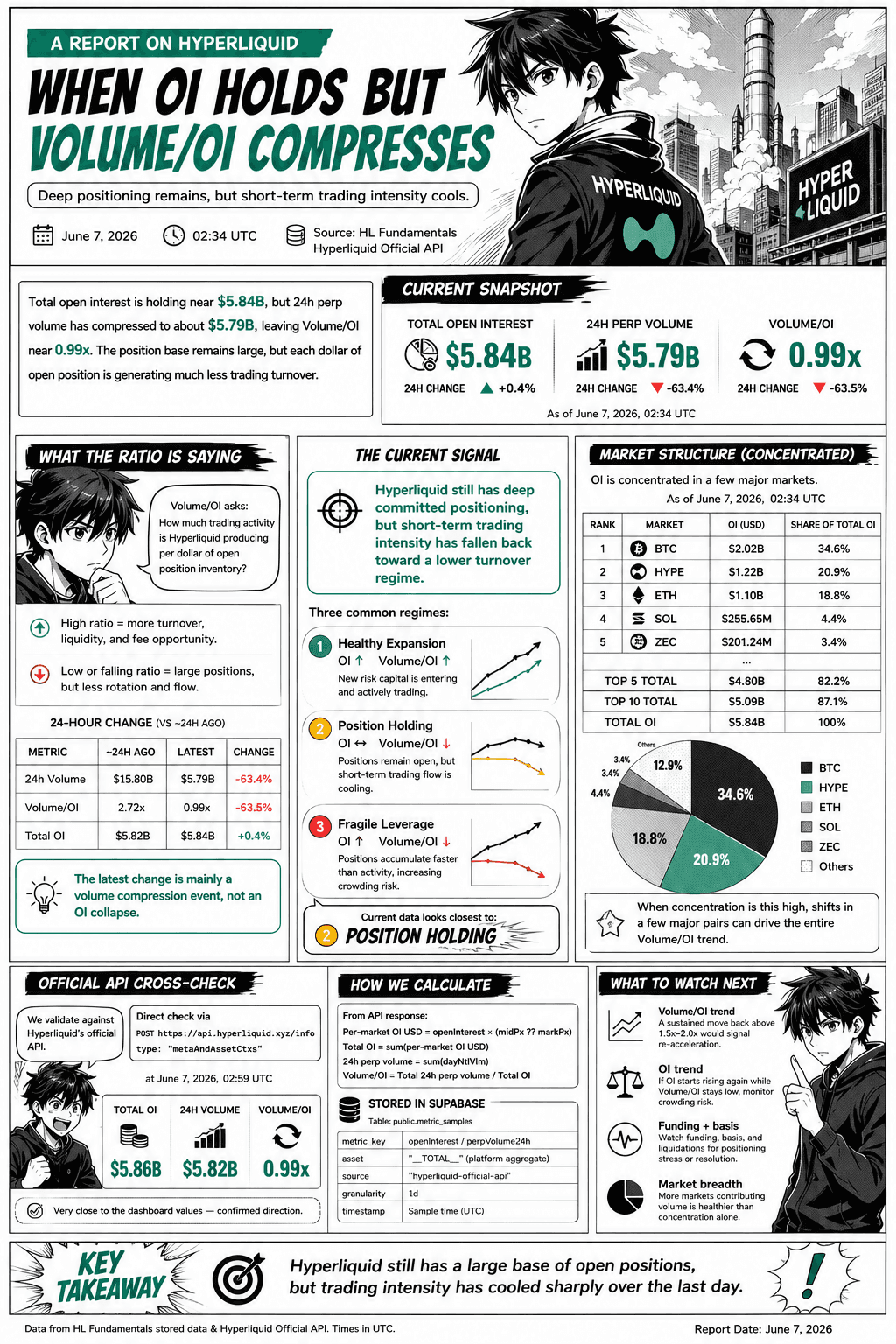
Total open interest is holding near $5.84B, but 24h perp volume has compressed to about $5.79B, leaving Volume/OI near 0.99x as of June 7, 2026, 02:34 UTC.
That means the current position base remains large, but each dollar of open position is generating much less trading turnover than it did one day ago.
For a derivatives venue, that distinction matters.
Open interest measures committed risk capital. Volume measures flow. Volume/OI measures how actively that committed risk is turning over.
Right now, Hyperliquid still has a large stock of open positions, but the flow around that stock has cooled sharply.
For background on why OI matters as a fundamentals signal, read What Total Open Interest Really Tells Us About Hyperliquid's Fundamentals.
Hyperliquid OI vs Volume/OI: Current Signal
The current signal is not "weak fundamentals."
It is more specific:
Hyperliquid still has deep committed positioning, but short-term trading intensity has fallen back toward a lower turnover regime.
In HL Fundamentals' stored data, Total OI was $5.84B at the latest sample. That was slightly above the nearest sample from roughly 24 hours earlier, when Total OI was $5.82B. The 24-hour change was only about +0.4%.
But the trading activity layer moved very differently.
The production dashboard's stored 24h volume series fell from $15.80B at June 6, 2026, 02:26 UTC to $5.79B at June 7, 2026, 02:34 UTC. Over the same window, Volume/OI fell from 2.72x to 0.99x.
So the most important live observation is:
OI is stable over the last day, while turnover has reset lower.
That usually points to one of three regimes:
| Regime | OI | Volume/OI | Interpretation |
|---|---|---|---|
| Healthy expansion | Rising | Rising | New risk capital is entering and actively trading. |
| Position holding | Stable | Falling | Positions remain open, but short-term trading flow is cooling. |
| Fragile leverage | Rising | Falling | Positions accumulate faster than activity, increasing crowding risk. |
The current data looks closest to position holding, not broad expansion.
What Hyperliquid Volume/OI Is Saying
Volume/OI is the simplest way to ask:
How much trading activity is Hyperliquid producing per dollar of open position inventory?
A high ratio means the same OI base is producing more turnover, liquidity, and fee opportunity.
A low or falling ratio means the platform may still have large open positions, but those positions are not rotating as actively.
In the latest stored series:
| Metric | Recent high in visible stored series | Latest | Change |
|---|---|---|---|
| 24h volume | $15.80B | $5.79B | -63.4% |
| Volume/OI | 2.72x | 0.99x | -63.5% |
| Total OI | $5.82B near prior-day comparison | $5.84B | +0.4% |
The implication is clear: the latest change is mainly a volume compression event, not an OI collapse.
That is a better setup than forced deleveraging, because open positions did not disappear. But it is still a cooling signal, because the system is currently producing less trading flow per unit of committed exposure.
How HL Fundamentals Calculates Hyperliquid OI and 24h Volume
HL Fundamentals collects this data from Hyperliquid's official POST https://api.hyperliquid.xyz/info endpoint using type: "metaAndAssetCtxs". Hyperliquid's own docs describe this endpoint as retrieving perpetual asset contexts including mark price, funding, and open interest.1
The project then calculates:
Per-market OI USD = openInterest * (midPx ?? markPx)
Total OI = sum(per-market OI USD)
24h perp volume = sum(dayNtlVlm)
Volume/OI = Total 24h perp volume / Total OI
The collected rows are stored in Supabase public.metric_samples with:
| Field | Usage |
|---|---|
metric_key = "openInterest" | Total and per-market OI samples |
metric_key = "perpVolume24h" | Total and per-market 24h volume samples |
asset = "__TOTAL__" | Platform-level aggregate row |
source = "hyperliquid-official-api" | Source label used by the project |
A direct official API check at June 7, 2026, 02:59 UTC produced a very similar read: roughly $5.86B Total OI, $5.82B 24h volume, and 0.99x Volume/OI. That confirms the production-stored dashboard value is not stale in direction.
Hyperliquid Market Structure: Large, But Concentrated
The latest stored OI base is still concentrated in a small number of markets.
At June 7, 2026, 02:34 UTC:
| Rank | Market | OI | Share of Total OI |
|---|---|---|---|
| 1 | BTC | $2.02B | 34.6% |
| 2 | HYPE | $1.22B | 20.9% |
| 3 | ETH | $1.10B | 18.8% |
| 4 | SOL | $255.65M | 4.4% |
| 5 | ZEC | $201.24M | 3.4% |
The top five markets represented about 82.2% of Total OI. The top ten represented about 87.1%.
That concentration changes the interpretation of Volume/OI.
When the market is this concentrated, a cooling in turnover can be driven by a few major pairs rather than a platform-wide loss of relevance. BTC, HYPE, and ETH alone explain most of the open position base. If activity slows in those markets, platform-level Volume/OI will fall even if smaller markets remain active.
This is why the next useful Live Insight should separate:
- BTC/ETH turnover.
- HYPE turnover.
- Long-tail and HIP-3 turnover.
The platform-level ratio is useful, but it hides where the cooling is happening.
News Context: The Structural Story Is Still Expansionary
The short-term data is cooling, but the broader news context remains structurally expansionary.
First, Hyperliquid has already demonstrated large-scale perp demand. In April 2025, Blockworks cited Blockworks Research saying Hyperliquid averaged $6.4B in daily trading volume over the prior three months, with BTC OI on Hyperliquid at $1.4B at that time.2
Second, Hyperliquid has faced stronger perp DEX competition. Blockworks later noted that Aster's entry compressed Hyperliquid's share among leading perp DEXs, even while Hyperliquid still maintained strong absolute average daily volume.3
Third, HIP-3 expanded the addressable market beyond crypto-native perps. CoinMarketCap reported that HIP-3 exchanges reached more than $790M in open interest, driven by commodities trading, and framed HIP-3 as permissionless deployment of perp markets on HyperCore infrastructure.4
Fourth, commodity perps have become part of the market narrative. Buildix reported in April 2026 that crude oil perps on Hyperliquid reached $840M in 24h volume and described HIP-3 as enabling markets such as oil, gold, silver, equity indices, single-stock exposures, and forex pairs.5
Together, those sources point to an important distinction:
The long-term Hyperliquid story is market expansion, but the current live data is turnover compression.
Those two statements can both be true.
HIP-3 and RWA perps may expand Hyperliquid's total opportunity set. But Volume/OI still has to confirm whether that opportunity is turning into durable, recurring trading intensity.
Why This Matters For Fundamentals
For HL Fundamentals, Total OI alone is not enough.
High OI says traders are willing to keep risk open on Hyperliquid. That is a strong trust and liquidity signal.
But high OI with falling Volume/OI says something different:
The platform is carrying substantial open exposure, but the latest flow around that exposure is less active.
This matters for three reasons.
1. Fee Potential Depends On Flow
OI is position inventory. Fees come from trading activity.
If OI remains high but volume falls, revenue potential per dollar of open position declines. The venue may still be important, but the short-term monetization efficiency is weaker.
2. Liquidity Quality Depends On Rotation
Deep OI can support liquidity, but turnover is what shows whether participants are actively entering, exiting, hedging, and arbitraging.
When Volume/OI falls, the market may be shifting from active trading to position holding.
That is not automatically negative. It can mean traders have conviction and are not closing positions. But it does reduce the evidence for broad-based short-term activity.
3. Risk Interpretation Changes
Stable OI with falling volume is usually less alarming than rising OI with falling volume.
If OI were rising rapidly while Volume/OI compressed, the concern would be crowded leverage.
Here, OI is broadly stable over 24 hours and down from the prior week. That makes the current setup look more like reduced activity after a high-volume period than new leverage buildup.
Live Read
The current Hyperliquid read is:
Neutral to mixed. Total OI remains large and slightly firmer over 24 hours, but 24h volume and Volume/OI have sharply compressed. The platform still shows strong committed positioning, while short-term trading intensity has cooled.
The signal would improve if:
- Volume/OI recovers above 1.5x without OI falling.
- OI begins rebuilding from the June 6 low while volume expands.
- Turnover improves outside BTC, HYPE, and ETH, showing broader market participation.
- HIP-3 and non-crypto markets contribute visible incremental OI and volume rather than only narrative value.
The signal would weaken if:
- OI falls while Volume/OI stays below 1.0x.
- BTC/HYPE/ETH concentration rises further.
- Volume recovery depends on only one market or one volatility event.
- News remains expansionary but stored platform activity does not confirm it.
Bottom Line
Hyperliquid's current Total OI still shows a large base of committed risk capital.
But the Volume/OI reset is the more important live signal today.
The market is not telling us that Hyperliquid has lost structural relevance. It is telling us that the latest activity per dollar of open position has cooled materially.
For a fundamentals dashboard, that is exactly why OI and Volume/OI should be read together:
OI tells us how much risk capital is staying. Volume/OI tells us how alive that capital is.
Today, the capital is still there. The turnover is quieter.